
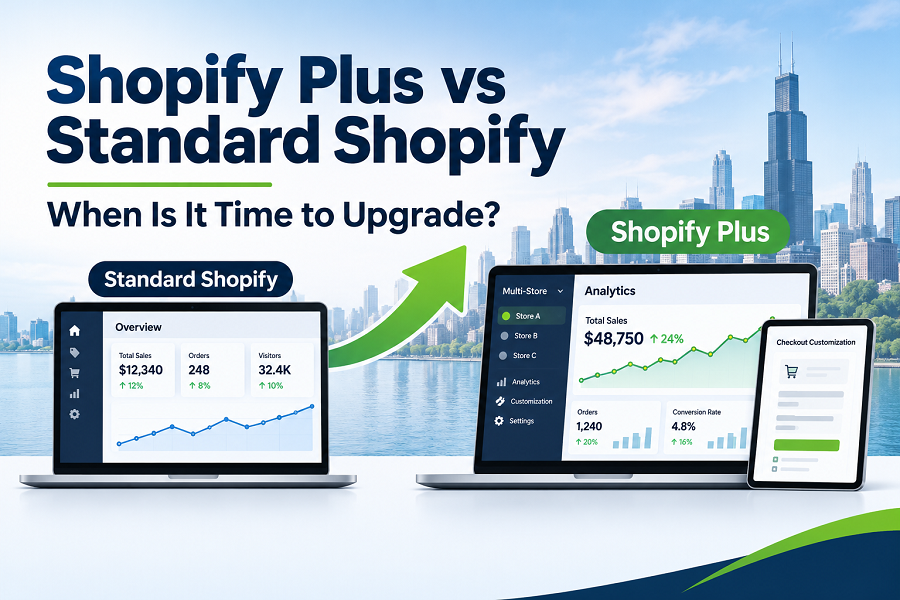
Stay on standard Shopify until your store is doing around $1 million a year, your checkout needs custom rules, or your site slows down when traffic spikes. That’s a rule of thumb, not a law, but it holds up for most brands. Past those points, Shopify Plus often pays for itself. Before them, it’s usually an expensive extra. Below, we break down the real differences, the costs, and the signs that it’s time to move. If you want a second opinion from a team that provides web design services Chicago IL businesses trust us; we’re glad to look at your numbers.
What Is the Difference Between Shopify Plus and Standard Shopify?
Standard Shopify (the Basic, Grow, and Advanced plans) is built for most online stores. You get hosting, a checkout, payment tools, and an app store. Shopify Plus is the enterprise tier. It runs on the same platform but adds more control over checkout, automation, wholesale selling, and multiple storefronts, plus a dedicated support contact. Think of it like a well-equipped delivery van versus a fleet with its own dispatch team. Both get packages to the door. One is built for volume and complexity.
Here is what actually changes when you move up:
- Checkout control: Plus lets you customize checkout logic and branding. Standard plans allow only light changes.
- Automation: Shopify Flow and Launchpad (scheduled sales and product drops) take repetitive work off your team.
- Wholesale and B2B: Plus, it includes company accounts, custom price lists, and payment terms in the same store.
- Multiple stores: You can run several storefronts for different brands, regions, or currencies under one agreement.
- Staff accounts and API limits: Higher limits matter once you connect inventory, ERP or CRM tools.
- Support: Plus comes with a launch engineer and priority help.
How Much Does Shopify Plus Cost Compared With Standard Shopify?

Standard Shopify plans run from about $39 to $399 a month on yearly billing. Shopify Plus starts around $2,300 a month on a three-year term, and it charges a percentage of sales once you pass a revenue threshold. Shopify updates its pricing from time to time, so check their pricing page before you decide.
That gap comes to roughly $27,000 a year at the low end, and that’s before development, apps, and migration work. So the question isn’t “can I afford Plus?” It’s “Will Plus bring back more than it costs?” If better checkout, faster pages, and less manual work add up to more than the extra spend, upgrade. If not, wait.
Quick fact: A Deloitte study on mobile speed found that a 0.1 second improvement in load time lifted retail conversions by about 8%. Speed is money, and it’s often fixable without changing plans.
Not sure which side of the line your store is on? Book a quick store review, and we’ll tell you honestly whether Plus makes sense.
When Is It Time to Upgrade to Shopify Plus?
Upgrade when your current plan is costing you sales or staff hours, not just because traffic went up. These are the signs we see most often:
- Your yearly sales are near or above $1 million and still climbing.
- Your checkout needs custom rules, such as tiered discounts, delivery date selection, or extra order fields.
- You sell wholesale and retail from one catalog and keep juggling spreadsheets for B2B pricing.
- You manage several brands, countries, or currencies in separate stores by hand.
- Flash sales and holiday traffic slow your site down or cause errors.
- Your team spends hours each week on tagging orders, syncing stock, or copying data between tools.
- More than 15 people need access to your store admin.
If you check three or more, it’s time to run the numbers. If you check one or two, a better setup on standard Shopify usually solves the problem.
Pro tip: Write down the three things that frustrate your team the most. Then ask whether Plus fixes each one. If the answer is “no” for most of them, you don’t need Plus yet.
Can Standard Shopify Handle a Growing Store?
Yes, and further than most people expect. Plenty of seven-figure stores run on the Advanced plan without trouble. Before you pay for Plus, check the basics: theme speed, the number of installed apps, product data quality, and checkout friction. In many cases, the real problem is a heavy theme with 20 apps stacked on top, not the plan itself.
A clean, fast build often does more for conversions than a plan upgrade. If you want to see what good looks like, this guide on what makes a high-performing website design in 2026 covers the page speed, layout, and trust signals that move shoppers to buy. And remember that traffic feeds all of this, so steady search engine optimization work matters whichever plan you’re on.
What Does It Take to Move From Standard Shopify to Plus?
Short answer: usually two to eight weeks, depending on how much custom work you need. You’re staying on the same platform, so you don’t rebuild from scratch. You switch plans, then rebuild checkout customizations, set up Flow automations, load B2B catalogs, connect your other systems, and test everything before launch.
Many brands pair the upgrade with a refresh of the storefront. That’s where a local partner helps. Our team handles e-commerce development Chicago projects from theme work to integrations, and we’ve seen what happens when a migration is rushed: broken discount codes, missing redirects, and a dip in rankings. A short test period before launch avoids almost all of it.
If you’re still weighing options, our article on how e-commerce development services drive online sales growth shows where the money tends to come from.
Is Shopify Plus Worth It for a Small Chicago Business?
Usually not at the start. A boutique in Wicker Park or a local food brand shipping nationwide can do very well on Basic or Grow. It becomes worth it when the business model gets more complex, for example, a Chicago brand that sells direct to shoppers and also supplies restaurants or retailers with wholesale pricing. That’s where Plus’s B2B tools earn their keep.
Small teams often get more from a good build than a bigger plan. Our post on e-commerce development services for small businesses explains how to spend your first dollars where they count.
How Do You Decide? A Simple Three-Step Check
- Add up the extra yearly cost. Plus fees, plus any apps you’d replace, plus one-time migration work.
- Estimate the sales gain. If you do $1.5 million a year and a faster, more flexible checkout lifts conversions by 10%, that’s about $150,000 more.
- Count the hours saved. Multiply weekly manual hours by your team’s hourly cost, then by 52.
If steps two and three together beat step one, upgrade. If they don’t, spend that money on speed, design, and marketing first.
Want help running this math with your real numbers? Talk to our team, and we’ll walk through it with you—no pressure.
Shopify Plus FAQs
Is Shopify Plus worth it for a store under $1 million in sales?
Usually no. Unless you need B2B tools, multiple storefronts, or custom checkout rules, the Advanced plan covers you.
Can I go back to standard Shopify after upgrading?
Yes, you can downgrade, but contract terms apply, and some Plus-only features will stop working. Read your agreement first.
Does Shopify Plus help with SEO?
Not directly. Faster pages and cleaner structure help, but content, links, and product pages still do the heavy lifting.
Will my theme and apps still work after the move?
Mostly yes. Checkout customizations are the part that usually needs to be rebuilt.
How long does the upgrade take?
About two to eight weeks for most stores, longer with complex integrations.
Final Thoughts
The right time to upgrade is when Shopify Plus solves a problem that’s costing you more than the plan does. Until then, a fast, well-built store on standard Shopify does the job. If you’re in Chicago and want help with the build, the migration, or the numbers, IBWD Computer Services offers web design services Chicago IL brands use for exactly these decisions, from e-commerce web design Chicago shop e-commerce development, which Chicago teams can rely on. Our work spans web development that Chicago companies ask for, including e-commerce website design Chicago retailers want and e-commerce website development in Chicago for growing stores. As a web development company Chicago owners can call on, we cover e-commerce development in Chicago, web design Chicago projects, and full website design services Chicago businesses need.
Ready to make the call? Book your strategy session with IBWD Computer Services and see our past work in the portfolio.
